Undying Tales
Do you like nature? Do you like mythology? Do you have an itch to draw something and are looking for inspiration? Check out this challenge list featuring endangered creatures and the myths, lore, stories that surround them. I will be exploring this list of species through the month of October and I invite any artist to join me in this celebration of nature in using these prompts and lore snippets, and tagging #UndyingTalesProject on Instagram. Each year, a new list is compiled and over the course of 30 days, we make our way across the corners of globe depicting species and stories.
Profit from the sale of these 15 original drawings by Stephanie Law will be going to various environmental charities. Subscribe below if you are interested in being added to the daily mailing notification that will be sent out when each drawing is done in October. Original pieces are usually sold the day of release, and email time is randomized throughout the day to let people around the globe have a chance at claiming pieces.

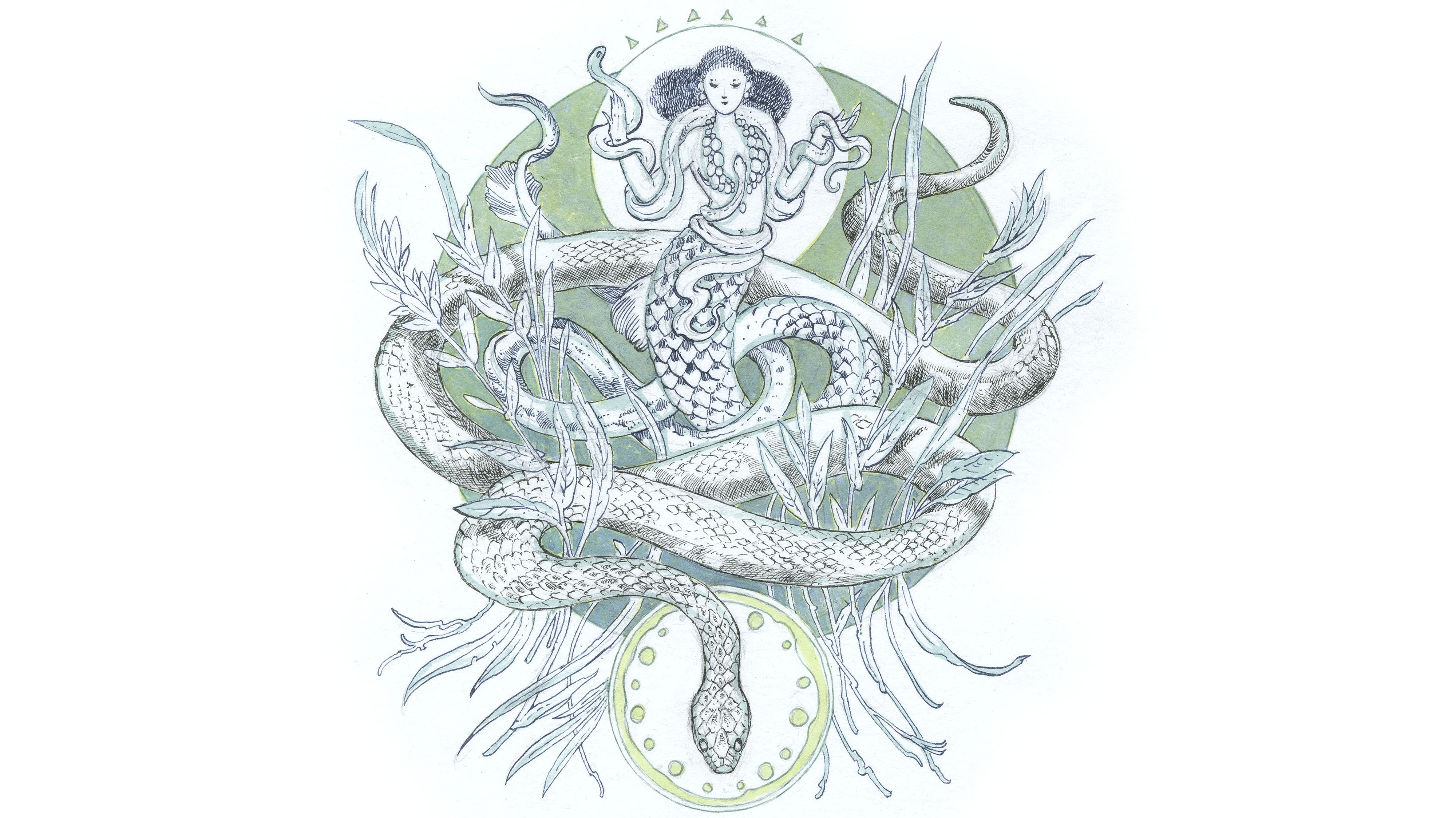
Oct 2: Giant Barb
Scientific Name: Catlocarpio siamensis
Status: Critically endangered. Very few of them survive to maturity because fishing and exploitation of the river basins takes its toll.
Also known as Siamese Carp, and locally in Cambodia as "Trei Kol Reang". It is a freshwater fish that lives in the Mekong, Chao Phraya, and Maeklong river basins. This aquatic behemoth is the national fish of Cambodia, growing up to three meters in length and is known as the "King of Fish".
At the Ankor Wat temple, there is a 49 meter stone bas-relief carving depicting the Hindu creation myth – the Churning of the Sea of Milk, in which gods and demons work together to bring forth an elixir of immortality. Throughout this carving are depicted fish, highlighting their importance to the daily lives of people and the peoples' entwined relationship with the aquatic ecosystem.
The Kymer have a regional version of the Ramayana, called the Reamker, from the 16th century. Suvannamaccha (whose name means "golden fish") is the mermaid daughter of Ravana, the demon that abducts Rama's wife. When Rama and his friends attempt to build a bridge across the sea to Lanka, they find that their efforts are undone each night. All the rocks that they use to create a causeway keep vanishing. Rama's companion Hanuman, the monkey god, goes to find out the reason and finds a cohort of fish or mermaids led by Suvannamaccha stealing away their efforts underwater. Hanuman falls in love with her, impressed by her wiliness, and when he tells the reason they are building the bridge, and of her father's evil actions, she finds sympathy and returns Hanuman's love, and ceases her efforts to deter the building of the bridge.
References:
Oct 4: North American Fisher
Scientific Name: Pekania pennanti
Status: While overall not endangered, regional populations are endangered, particularly those along the West Coast in the southern Sierra Nevada regions, due to habitat loss, climate change, and historical over-trapping.
The Ojibwe have a story of how clever and brave Fisher brought Summer and warm weather to the earth.
A long time ago, it was very cold, and the only season was winter. Seeing his son and wife so cold, Fisher gathered together his friends: Otter, Lynx, Badger, and Wolverine to embark on a journey north across the frozen rivers and snow-covered lands, and up into a high up mountain that the wise ones had told Fisher to climb.
Upon reaching the peak, they found the sky stretched taut like a drum, and each of the companions attempted to jump and break through, until finally Wolverine was able to breach the sky. After his attempt, Fisher leaped through the hole and found himself in the sky country filled with springtime warmth, and birds caught up in hanging baskets.
He broke the baskets and as the birds streamed forth, the sky-people gave chase, shooting arrows at Fisher, who leaped back through the hole in the sky, followed by all the birds of summer and the warmth they carried with them. Some of the arrows struck Fisher, and in the constellation in the sky, you can still see how his tail is crooked, where the arrows struck him.
References:
Oct 6: Asian Golden Cat
Scientific Name: Catopuma temminckii
Status: Vulnerable. Threatened by poaching and deforestation of their habitat.
In Thailand there is a superstition about a spirit called Cha kla. This is a malevolent ghost that manifests in the form of a wild jungle cat, but it is spectral and demonic in nature. It has pure black fur, with hair that grows in reverse, and blood red eyes.
The sight of, or the touch of Cha kla can cause death. They are dread omens of doom, but they are elusively shy nocturnal creatures, fleeing easily. Its domain is primarily the jungles of rural Thailand. When not roaming in the night, Cha kla lives in burrows underground.
Stories about Cha kla underscore fears about the unknown and the inexplicable dangers of the natural world. They are remnants of animistic practices and beliefs where malevolent energy is encapsulated in feline form. They are embodiments of gluttony with a ravenous nature, this being reflected in the very meaning of their name. Cha kla are created through sorcery to inflict vengeance upon or to curse enemies, or for protection, and they act as a familiar to the summoner.
While Cha kla are malevolent spirits, they are balanced by other spirit beliefs who collectively are the means by which communal peace and spiritual harmony is regulated. Belief in Phi is deeply rooted in the culture, predating Buddhism, and there are good and bad Phi that affect actions of daily life.
References:
Oct 8: Tufted Ground Squirrel
Scientific Name: Rheithrosciurus macrotis
Status: Vulnerable, due to loss of habitat and deforestation. Their habitat is lowland forests and hills. Endemic to Borneo.
In the Malay Peninsula, the Orang Asli people have folktales of squirrel, who is a clever problem-solver. One of these stories, as collected by folklorist Walter Skeat: The Friendship of the Squirrel and the Creeping Fish.
Tupai the Squirrel and Ruan the Creeping Fish were close friends. One day when Tupai's wife fell sick, the Medicine man prescribed egg of fowl, which he had no idea how to procure. Ruan offered to acquire it. The next day he swam into a bamboo tube a woman was filling at the river, and that night he crept out and took an egg back to the tube. When the woman went to fill the tube again in the morning, he swam away and brought the egg to Tupai.
It was Tupai's turn to return the favor when Ruan's wife fell ill and the cure was the heart of a crocodile. Tupai bit his way into the hollow of a coconut. The unsuspecting crocodile came upon and swallowed the coconut whole, including Tupai. The squirrel lay quietly until he was deep in the belly of the crocodile. At last he emerged, bit out the crocodile's heart. With agile leaps, he escaped from the dying crocodile, and returned with the heart for his friend Ruan to give to his wife and cure her.
References:
Oct 10: Kahuli Tree Snail
Scientific Name: Achatinella byronii
Status: Critically Endangered. There are 41 identified species of the Achatinella in Hawaii, but the majority of them are extinct, with only 13 species currently surviving, endangered. Most populations were wiped out by invasive predatory snail species, rats, and chameleons.
In Hawaii, it is said that snails sing, and though there is no biological evidence of such, this folklore is tied to various words or phrases that allude to snails and music. Traditionally, it is said that they create a chirping, trilling sound, pulsing in the night. The snails are celebrated in hula songs; the hula songs echoing the chanting rhythm attributed to the snails.
The summer palace of King Kamehameha III was called Kaniakapūpū "the singing of the land snails" because it is said that in his time the surrounding lands were so densely populated with these "jewels of the forest". The snails were revered and their shells were collected for leis that signified rank.
References:
Oct 12: Chinese Magnolia Tree
Scientific Name: Magnolia sinica
Status: Critically endangered from logging, and from excessive use in traditional Chinese medicine. Only 50 wild individuals remain.
Heralding the arrival of Spring, magnolia blossoms are the epitome of elegance. The smooth swirl of thick petals present like a delicate jade cup. In ancient China, magnolia trees were grown in the gardens of the Emperor's palace, and when a subject had particularly pleased him, the Emperor would bestow upon them a gift of one of the exquisite blooms.
Magnolias are associated with feminine grace, purity, and dignity. They also are symbolic of longevity, due to staying in bloom for such extended time.
Oct 14: Volcano Rabbit
Scientific Name: Romerolagus diazi
Status: Endangered. Its natural range is close to Mexico City, and so it has experienced severe habitat fragmentation as well as further habitat loss due to fires and agriculture.
There is a story of the sun and the moon in Aztec mythology. In the beginning of creation, the gods gathered at Teotihuacan. In a great fiery sacrifice, two gods were bid by the other gods to offer themselves upon the pyre. One of these was a powerful god named Tecciztecatl, but he could not bring himself to throw himself on the pyre. The other god, Nanhuatzin was weaker, but he did not hesitate. Ashamed, Tecciztecatl finally was able to follow through. And an eagle and jaguar also leaped into the pyre and sacrificed themselves, for which they were rewarded with becoming the representatives of Aztec military orders of knights.
Nanhuatzin arose as a sun, and Tecciztecatl as a second sun. The gods were concerned that two suns would bring excessive heat and light, and so they threw a rabbit at Tecciztecatl, and this dimmed his light. This is how Nanhuatzin became transformed into Tonatiuh, the sun god, and Tecciztecatl became the moon, upon which you can still see the impression of the rabbit. The gods sacrificed more of their number to Tonatiuh, and the sun began its arc across the sky.
Teotihucan is a city that predates the Aztecs, and it is unknown what Mesoamerican culture built the metropolis with some of the largest pyramids in pre-Columbian America. The name "Teotihucan" means "city of the gods", though archaeologists now say that the original name for the city might have been "Teohuacan" - "city of the sun", and this was changed by the Spanish when they conquered in order to downplay the connotations of rulership that the Sun represented.
References:
Oct 16: Philippine Long-tailed Macaque
Scientific Name: Macaca fascicularis philippensis
Status: Endangered.
In the cosmology of the Bagobo people of the Philippines, there are people who live on the moon. There is a pananag tree on the moon and white monkey who lives in its branches (and these are the shapes you can see when gazing upon the moon and observing the spots and shadows).
The monkey and the tree are not very clear however, and it is said that if anyone were to clearly view them, they would be stricken ill or die. Despite this, the monkey is not bad however, for he fights against evil buso, which are malicious spirits that prey upon humans. Buso are voracious, demonic creatures who hunger for human flesh. The clouds are intimidated by the monkey and this is why they skitter lightly across the face of the moon in the night.
References:
Oct 18: African Spurred Tortoise
Scientific Name: Centrochelys sulcata
Status: Endangered
In Igbo folktales, Tortoise is a roguish trickster. He is cunning, but gets into trouble.
One day, the sky people invited everyone to a feast. Tortoise heard of the great feast in the sky and wished dearly to attend, for he was famished. The birds were skeptical of his intentions, for they knew of his mischievous nature. Furthermore, he could not fly. But he convinced the birds to loan him some feathers so that he would be able to accompany them to the sky-feast.
When they arrived at the feast, the sky people invited the birds to eat, but Tortoise leapt ahead and asked "Who is this feast prepared for?"
When the man replied, "It is for all of you!" Tortoise immediately claimed, "Why, my name is All Of You!" And he began to eat all the choicest parts of the food that was laid out. The birds were very unhappy that he was so greedy and ungrateful to them, and at last when Tortoise had eaten everything, the hungry birds took back the feathers they had given him.
Tortoise asked that the birds tell his wife to lay out all his soft belongings on the ground below, for he would not be able to fly back now, but the birds were angry and changed the message and told Tortoise's wife to lay out all his hard belongings so that when Tortoise jumped, his shell cracked and shattered against the rocks.
His friends aided him in collecting the pieces and gluing his shell back together, but that is why to this day it is rough and craggy.
References:
Oct 20: Trung Son Pit Viper
Scientific Name: Trimeresurus truongsonensis
Status: Endangered. Endemic to Vietnam, they are endangered primarily because of habitat loss due to illegal logging and agricultural conversion.
In Vietnamese mythology, Ngoc Hoang is the supreme ruler of the heavens. Originally called Ong Troi but with the influence of Taoism, he became merged with the Chinese Jade Emperor.
Ngoc Hoang was the primordial creator of the earth, mountains, seas, and the sun. To fill the realm he made animals, plants, and human beings. At first he intended for humans to live forever, merely shedding their skins to be rejuvenated and to become young again. He sent the god Thu Rep as a messenger to Earth to share and teach this secret to humanity, however Thu Rep was waylaid by vipers, and in a cowardly bid for his life, he taught the regenerative skin-shedding to the snakes instead. And so humans never received that gift of immortality. Thu Rep was exiled for his failure.
In addition to being associated with rejuvenation and life, snakes are also associated with adaptability, health, fertility and growth. Temples of Mother Goddess Worship, Dao Mau, along the riverine regions are ornamented with protective snakes. They are carved or painted around the beams of the temples, guarding the sacred spaces. Snakes are seen as sacred protectors and companions to the water deities.
References:
Oct 22: Kakapo - Owl-faced Parrot
Scientific Name: Strigops habroptilus
Status: Critically Endangered. Introduced mammals to New Zealand nearly wiped out all kakapo, but conservation efforts have cleared four islands of these predators and carefully began to reintroduce kakapo to the wild.
The Maori have a story about the kakapo and the albatross (toroa). Toroa once lived on the land, while kakapo was a sea bird. But toroa's pennant wings were so brightly visible against the forest canopies, while kakapo's green plumage stood out against the frothing ocean swells. The two decided to swap places. Toroa's white feathers were much better suited to meld with the pale sea foam, while kakapo all but vanished into the verdant green bushes. So effective was kakapo's camouflage in the forest that eventually he did not even have a need or the ability for flight any longer, navigating with ease along the twilit forest floor. Its name means "night parrot"
References:
Oct 24: Koala
Scientific Name: Phascolarctos cinereus
Status: Vulnerable. Much of their habitat has been destroyed due to bushfires, clearing, climate change, and their population has further been devastated by disease.
In the arid mountains of the Carnavon ranges in Queensland, Australia, the Aboriginal Bidjara people have a story about how rain and trees first came to the region. In Dreamtime, the land was inhabited by koalas, kangaroos, and wallabees. The Bidjara tried to coax rain from the clouds by throwing their boomerangs, but were unsuccessful.
At last, they entreated the koala Didane to help. He sent his powerful boomerang into off into the clouds. The boomerang grew small in the distance, vanishing from sight. After a great length of time, seeds began to shower down from the clouds, and then water. The seeds took root and grew and became trees, and the water flowed into rivers to quench the parched land.
References:
Oct 26: Elephure
Scientific Name: Elaphurus davidianus
Status: Extinct in the Wild. Milu, or Pere David's Deer, were hunted almost to extinction in China in the 19th century. A few individuals were taken to zoos in Europe, and a herd belonging to the emperor of China. The latter were killed during famine and the last of them during the Boxer Rebellion. However, from the captive zoo animals, gradually larger herds have been bred, and now there are herds in China in nature reserves, and their population has grown to 15,000.
Its Chinese name is Sibuxiang, which translates as "Four Not Alike" because it's said to possess the hooves a cow (but it is not a cow), the antlers of a deer (but it is not a deer), the body of donkey (but it is not a donkey), and the tail of a horse (but it is not a horse), and they are semi-aquatic, possessing partially webbed hooves, for they spend much of their time feeding on plants in the Yellow River and Yangtze River basins.
With such a wide range of characteristics, the milu deer took on a mythic aspect. Many mythological creatures in Chinese folklore are described in similar fashion, as a chimera made up of familiar aspects of many everyday beasts. In the 16th century novel Fengshen Yanyi ("The Investiture of the Gods"), which combines history, folklore, and fantasy in a romanticized story of the overthrow of the last ruler of the Shang Dynasty, Jiang Ziya, one of the protagonists, rides upon a celestial milu deer. The King is bewitched by a fox spirit in the form of his concubine, and Jiang Ziya is called upon to assist in the war.
References:
Oct 28: Carolina Northern Flying Squirrel
Scientific Name: Glaucomys sabrinus coloratus
Status: Endangered due to over-logging of their native habitat, high elevation-spruce and fir forests.
This is the Cherokee story of how the bat and flying squirrel came to be. Once, the animals challenged the birds to a ball game. On the side of the animals was Bear, and Terrapin, and Deer. Bear was very strong, and Terrapin's heavy shell was an intimidating obstacle, and Deer was fleet-footed. The birds had Eagle and Hawk and Tlă′nuwă, swift and strong in their own right, but the animals were very intimidating.
Before the game began, a couple of small mice approached the birds and asked if they could join the team. The birds asked why they did not join the four-footed animals, and the mice said they had tried but been turned away for being too small.
After some consultation, the birds agreed to let them join, but they would need wings. Taking the skin of a drum, they cut out two leather wings and stretched them over some canes and attached these to one of the little creatures, and he became Bat. For the second mouse, they had run out of drum leather, so instead the birds took the skin of his body between their bills and stretched, and he became Flying Squirrel.
When the game commenced, Bat flitted about, agile and swift with the ball. Flying Squirrel ran through the trees, carrying the ball, leaping nimbly from one branch to the next and drifting down on his wings. The two were such great assets to their team that the birds easily won.
References:
Oct 30: Anaimalai flying frog
Scientific Name: Rhacophorus pseudomalabaricus
Status: Critically Endangered. Population is declining due to habitat loss, agricultural development, and deforestation, and cardamom farmers view them as pests to be exterminated. 80% of the frogs in India are on the verge of extinction, due to habitat loss. Amphibians' sensitivity to fluctuations in pollution makes them indicators of overall environmental health, and they are vital in the food chain.
In Sanskrit there is a nursery tale of a girl who is the sun, named Bheki ("frog"). She was very lovely, and one day she caught the eye of a king while she sat at the edge of a well. The king was enchanted and asked her to marry him, to which she agreed. "But," she warned him, "You must never show me a drop of water." The king must have thought this an odd request, but he agreed, for she was very beautiful.
One day, Bheki asked the king, "Please bring me some water." He forgot his promise, and as he brought her water, she vanished, slipping away as the sun vanished on the horizon over the sea, and the king never saw her again.
References: